

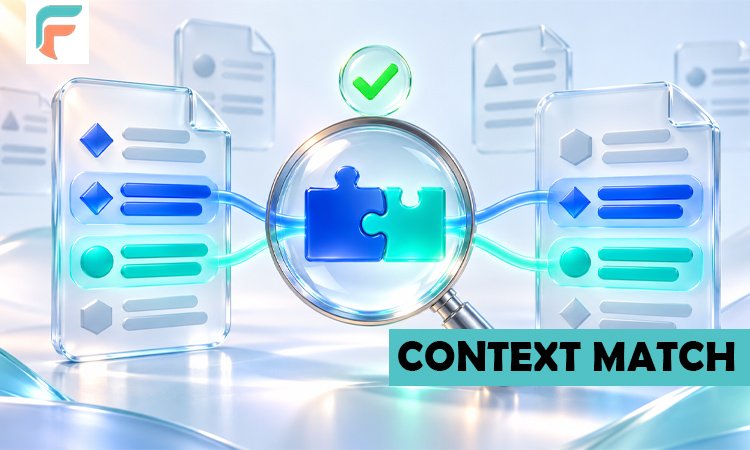
Have you ever searched for a word and got results that had nothing to do with what you meant? Or seen an ad that fit the article you were reading? Both of these come down to one idea: context.
“Context match” is a phrase that shows up in many places. A translator may use it in a work tool. An advertiser may use it to pick where an ad appears. A search engine may use the same idea to understand what you really want. The words are the same, but the details change from field to field.
In this guide, we will look at what context match means, where you can find it, and why it matters. We will use simple words and real examples. By the end, you will know the main ideas and be able to explain them to a friend.
What Does “Context Match” Mean?
Let’s start with the two words.
- Context is the situation around something. It is the words before and after a sentence, the topic of a page, or the reason someone is searching.
- Match means that two things fit together.
So, in the simplest sense, a context match happens when something fits not only by its own words, but also by the situation around it.
Think about the word “bank.” If you read “I sat on the bank and watched the river,” you know it means the side of a river. If you read “I went to the bank to get cash,” you know it means a place for money. The word is the same, but the context is different. A system that understands context can tell the two apart.
That is the heart of every kind of context match. The system does not look at one piece alone. It also looks at what is around it.
Why Context Match Matters
A plain word match is fast, but it can be wrong. Here are a few examples of what can go wrong without context:
- A translator reuses an old translation, but it does not fit the new sentence.
- An ad for a travel deal shows up next to a sad news story about a plane accident.
- A search for “apple” gives you fruit recipes when you wanted a phone.
Context match helps fix these problems. It makes results more useful, saves time, and makes people feel that a tool understands them.
Context Match in Translation Work
If you search for “context match” on Google, many results come from the world of translation. This is one of the clearest and most exact uses of the term.
A quick look at translation memory
Professional translators often use a tool called a translation memory, or TM. It is a database that stores sentences that were already translated. When the same or a similar sentence comes up again, the tool suggests the old translation. This saves time and keeps the wording the same across a project.
In tools like Trados Studio, a document is split into small parts called segments. Most of the time, a segment is one sentence.
The match types
According to the Trados developer documentation, there are four main results when the tool looks up a segment:
- No match. The memory has nothing like this sentence, so the translator starts from zero.
- Exact match (100%). The memory has an identical sentence.
- Context match (CM). This is like an exact match, but even more reliable. The sentence was seen in the same order as in an earlier document.
- Fuzzy match. The memory has a similar sentence, for example 90% alike. The translator usually has to change it a little.
How a context match is found
Here is the rule in plain words. A context match is better than a 100% match. For a segment to be a context match, the stored sentence must be a perfect match, and both sentences must have been placed after the same previous sentence.
Let’s look at an example.
Imagine you translated a manual before. It had these two lines in a row:
You see a window. Click it to select it.
Months later, you get a new manual. It has the same two lines in the same order. The second line, “Click it to select it,” is not only identical. It also comes after the same sentence as before. That makes it a context match.
Why does this matter? In many languages, a short sentence like “Click it to select it” changes depending on the word before it. In German, for example, the word for “it” changes with the thing you are talking about. A window and a button need different words. The context match tells the translator that the stored translation was made for this exact situation.
Context match and PerfectMatch
Trados also has a related feature called PerfectMatch. It compares a new version of a file with an older, already translated version of the same file, instead of using the memory. It is a form of context match and is seen as even more reliable, because it uses the full context of the document.
Why translators like context matches
- They are very reliable, so there is less to check.
- They save time and money, because the work is already done.
- They keep the wording the same across many documents.
Context Match in Online Advertising
The second big area is advertising. Here, the same idea is usually called contextual targeting or contextual advertising.
What it is
Contextual advertising shows ads based on the content of the page a person is reading. It does not need to know who the person is. If you read an article about cycling, you may see an ad for bike helmets.
Google explains it this way in the Google Ads Help Center. The system looks at each webpage and finds its main theme. Then it matches that theme to your ad, using the keywords or topics you chose, along with your language and location.
A simple example
Google gives this example. Say you choose “bikes” as a topic and “cycling” as a keyword. Your ads can then show on content that matches either one.
So the match is between your ad and the page. If the page fits your topic, your ad can appear there.
Contextual vs behavioral targeting
There is another way to show ads, called behavioral targeting. It uses a person’s past actions, such as sites they visited or things they bought.
Here is the difference:
| Contextual targeting | Behavioral targeting | |
|---|---|---|
| What it looks at | The content of the page | The history of the person |
| Needs personal data? | No | Yes |
| Privacy | Friendlier | More worries |
Because contextual targeting does not follow people around the web, many advertisers see it as a good choice when privacy rules get stricter and tracking cookies are used less.
Old keyword matching vs smarter matching
Early contextual systems mostly matched keywords. This caused mistakes. For example, the word “crash” can appear in an article about car safety and in an article about a plane accident. Simple keyword matching may treat both pages the same.
Newer tools use language technology to understand the meaning, tone, and topic of a page. They can tell the difference between an article that praises a topic and one that criticizes it. This is a deeper kind of context match.
Context Match in Search and AI
The third area is search. Think about how you use Google. You type a few words, and you expect good answers, even if your words are not perfect.
Keyword search vs semantic search
- Keyword search looks for the exact words you typed. It works well for things like product codes, names, or error numbers.
- Semantic search tries to understand the meaning and intent behind your words. It can find pages that use different words but talk about the same idea.
One example from a search guide: a system with semantic search can understand that “leave policy” and “PTO guidelines” point to the same thing. Another example: a search for “laptop for editing 4K videos” can bring up pages about strong processors and graphics cards, even if those exact words are not in your search.
Where context comes in
Context can also include things like what you asked before in a chat, where you are, or what you like. Search tools can add these signals on top of normal search. Many modern systems mix both methods. They use exact words when precision matters and meaning when the question is open.
This is why you can often type a messy question and still get a useful answer. The system is trying to match your situation, not only your words.
Where it can go wrong
Context matching is not perfect. Some common problems include:
- Unclear context. If the situation is not clear, the system may guess wrong.
- Bad data. If the data used to learn patterns is poor or unfair, the results can be unfair too.
- Context drift. In a long chat or a long document, the system may slowly lose track of the main topic.
It is good to remember that a smart match is still only a best guess.
Context Match in Word Games
There is also a fun side. Some word games use context as the main idea. In one app, you guess a hidden word by trying words that are often used with it. The closer your guess is in meaning, the closer you are to the answer.
This is a small, playful example of the same thing. Words are not alone. They live near other words, and those neighbors tell us a lot.
How to Make Your Own Content Match Context
If you write a blog, run a website, or make ads, you can use these ideas right now. Here are some practical tips.
- Know the reason behind the search. Ask yourself: what does this person really want? An answer, a price, a guide, or a comparison?
- Answer the question early. Put the main answer near the top. Then add details below.
- Use clear headings. Short headings that look like real questions help both readers and search engines.
- Cover related ideas. If you write about one topic, add the closely related points people usually ask about next.
- Do not stuff keywords. Write the way people speak. Modern search tools understand meaning, so repeating a phrase too many times does not help.
- Pick the right place for your ads. If you advertise, choose topics and pages that fit your product. A good fit is better than a big audience.
- Check your results. Look at where your ads or pages appear. If the fit is poor, change your keywords or topics.
Quick Summary
- Context match means that two things fit together because of the situation around them, not only their words.
- In translation, a context match is a stored sentence that is identical and was also placed after the same previous sentence. It is more reliable than a 100% match.
- In advertising, it means showing an ad that fits the topic of the page, without using the reader’s personal history.
- In search and AI, it means understanding meaning and intent, not only exact words.
- It is helpful, but it can still make mistakes.
Final Thoughts
Context match is not a hard idea. It simply means that we should look at the whole picture, not just one piece. Translators use it to save time and keep texts consistent. Advertisers use it to show ads that feel natural. Search tools use it to understand what we mean.
When you write or build anything for other people, ask one question: does this fit the situation my reader is in? If the answer is yes, you are already thinking in terms of context match.
Frequently Asked Questions
1. What is context match in simple words?
It is when something fits not just because the words are the same, but because the situation around it is the same too. The “situation” can be the sentence before, the topic of a page, or the reason behind a search.
2. Is context match the same as an exact match?
No. An exact match only checks that the text is identical. A context match also checks the surroundings. In translation tools, a context match is more reliable than a 100% match.
3. What does CM mean in Trados Studio?
CM stands for context match. It is a label the tool shows when a stored sentence is identical to the new one and both come after the same previous sentence.
4. How is a context match different from a fuzzy match?
A fuzzy match is only similar, for example 90% alike, so the translator usually needs to edit it. A context match is identical and also fits the same position, so it can usually be used as it is. It is still a good idea to read it once.
5. What is the difference between context match and PerfectMatch?
PerfectMatch compares a new version of a file with an older translated version of the same file. It is seen as a form of context match, and it is considered very reliable because it looks at the whole document context.
6. What is contextual targeting in advertising?
It is a way to show ads based on the content of the page. For example, a cooking article can show ads for kitchen tools. It does not need the reader’s browsing history.
7. Does contextual advertising use my personal data?
Contextual targeting is built to look at the page, not the person. This is why it is often seen as more privacy-friendly than behavioral targeting. However, an ad platform may still use other settings, so it is wise to read the privacy rules of each platform.
8. How is context match used in Google search?
Google and other search tools try to understand the meaning and intent behind your words, not only the exact terms. This is part of semantic search. Exact words still matter, so the best systems use both.
9. Can context matching make mistakes?
Yes. It can guess wrong when the situation is unclear, when the data behind it is poor, or when a long text makes it lose the main topic. A human check is still helpful for important work.
10. How can I use context match to improve my website or ads?
Write for the real reason behind the search, answer the main question early, and use clear headings. For ads, choose topics and pages that truly fit your product. A strong fit usually works better than a large audience that does not care.