

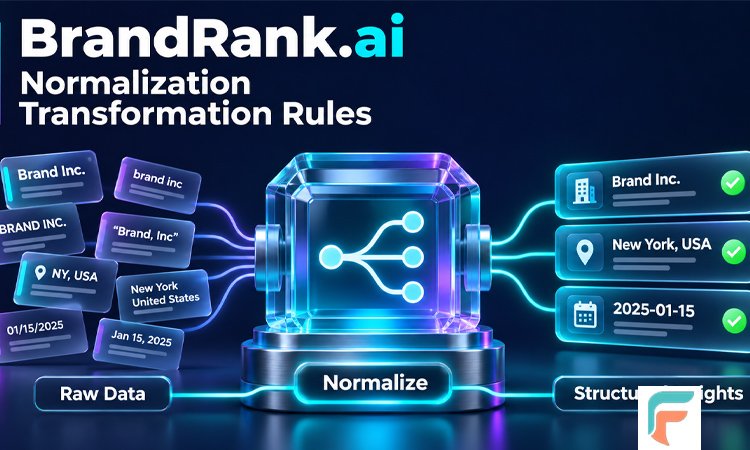
If you typed “BrandRank.ai normalization transformation rules” into Google, you probably expected to find a clear rulebook. Maybe a list of steps, maybe a technical guide from the company itself. Instead, you found many articles that sound alike, and most of them make big claims without showing where the facts come from.
This guide is different. We will look at what BrandRank.AI really does, what the words “normalization” and “transformation” mean, and how they connect to the way AI tools talk about brands. We will also be honest about one important point: the exact phrase is not an official BrandRank.AI document.
By the end, you will know what is true, what is only a helpful idea, and what you can do today to make your brand easier for AI tools to understand.
Quick Summary
- BrandRank.AI is a real company that checks how brands appear in AI answers.
- We found no public page from BrandRank.AI that defines a rulebook called “normalization transformation rules.”
- Normalization and transformation are real data practices. They help turn messy information into clean, steady information.
- You can use the same ideas to keep your brand name, products, and facts clear across the web.
What Is BrandRank.AI?
BrandRank.AI is a software company based in Cincinnati, Ohio. It builds a platform that watches how AI answer tools talk about brands. These tools include ChatGPT, Gemini, Perplexity, Grok, Claude, Meta AI, and DeepSeek, according to the company’s own website.
Think about how people search now. Many people no longer scroll through ten blue links. They ask an AI tool a question and get one short answer. That answer may name a few brands, skip others, or even say something wrong. BrandRank.AI helps brands see this and react.
The company says its platform looks at three main areas:
- AI Search Visibility. How often your brand shows up in AI answers, and how you compare with your competitors.
- Brand Vulnerability. How safe and correct the claims about your brand are. This covers trust, product facts, and the tone of what AI says.
- Content Readiness. How easy it is for AI systems to read and use your content. Clear structure and good data help here.
The platform also has a metric called Recommendation Share. It shows how often an AI answer actually names your brand as the pick, not just mentions it in passing. A tool called Brand Risk Monitor looks for false or old claims, such as a recall that ended long ago but still appears in AI answers.
In 2026, the company was also named a Representative Vendor in the Gartner Market Guide for Answer Engine Visibility Tools, as reported in its funding news.
The Real Framework: Brand Health and Trust
Here is where many articles go wrong. When BrandRank.AI talks about its method in public, it uses the name Brand Health and Trust framework. You will not find “normalization transformation rules” as a product name on its site.
On April 16, 2026, Burke, Inc. (a data and insights company) and BrandRank.AI announced a partnership. The first product from that team is called BRAND ANSWER. According to the press release, it shows how AI answers describe a brand, where the brand is missing from key questions that shoppers ask, and how it compares with competitors.
The partnership also mixes BrandRank.AI’s data with Burke’s brand strategy work, so the numbers are tied to real human behavior. One news report on the launch also notes that 47% of consumers worry about how accurate and fair AI answers are. That is a big reason brands now care about what AI says about them.
So the verified story is simple: a real company, a real framework, and a real tool. The phrase “normalization transformation rules” is something other writers added later.
Where Did the Phrase Come From?
We can only guess, but the story is easy to follow. People search for BrandRank.AI. People also search for data terms like normalization. Some writers joined the two ideas into one phrase, and many blogs copied it. After a while, the phrase looked official, even though no company page said so.
Several of the articles that rank for this keyword say the same thing. They admit that BrandRank.AI has not shared a public document with this name, and that its exact scoring method is private. We agree with them. If an article tells you it knows the “secret 7-step rules” inside BrandRank.AI, be careful. Ask where the writer got that information.
This does not mean the topic is useless. The ideas behind the words are real, and they matter for brands. Let us look at them one by one.
What Does Normalization Mean?
In data work, normalization means making similar things look the same, so a computer can treat them as one thing.
Here is a simple example. Imagine your company is called BrandRank.AI. People may write it in many ways:
- BrandRank.AI
- BrandRank AI
- Brandrank.ai
- Brand Rank AI
A human sees one company. A computer system may see four different names. Normalization is the step that cleans these names and puts them in one standard form.
One data guide on source normalization explains an important point: normalization is not just about looks. Formatting changes how data appears. Normalization makes sure the meaning stays steady and a machine can read it correctly. The same guide gives a date example. If you change 03/04/2025 into a new style without knowing the country format, you might save the wrong date.
Common normalization steps include:
- Making letters lowercase or using one standard style
- Removing extra spaces and strange symbols
- Fixing spelling variations
- Removing endings such as Inc., LLC, or Ltd. when they only add noise
- Using one standard format for dates, units, and places
What Does Transformation Mean?
Transformation is the bigger job of changing data from one shape into another shape that a system can use. Normalization is one part of it.
For an AI visibility tool, the raw data is a long text answer from a chatbot. A person can read that answer easily, but a report cannot count it. So the system turns the text into fields, for example:
- Which brands were named
- Which websites were cited as sources
- Whether the tone was positive, neutral, or negative
- Which competitors appeared in the same answer
- Whether a claim was correct
Once the answer is in these fields, a team can count, compare, and track the results week after week.
Normalization vs. Transformation: A Simple Table
| Topic | Normalization | Transformation |
|---|---|---|
| Main goal | Make equal things look equal | Change data into a new, useful shape |
| Example input | “Brand Rank AI” and “brandrank.ai” | A long chatbot answer |
| Example output | One standard brand name | Fields like mentions, sources, and tone |
| Main risk | Joining two different brands by mistake | Changing the meaning without an error |
Normalization Is Not the Same as Entity Resolution
There is one more term worth knowing: entity resolution. It means deciding whether two records point to the same real-world thing, such as a person, a company, or a product.
An article on entity name normalization makes the difference clear. Normalization makes names easier to compare. Entity resolution decides whether names that look alike are really the same entity. This matters because two names can look almost the same and still be different companies.
Experts also warn that entity resolution is hard. Similar does not always mean identical. That is why good systems keep humans in the loop for tricky cases.
When an AI model reads the web, it faces this problem every day. If it sees “BrandRank AI” in one place and “BrandRank.ai” in another, it has to decide if these are the same company. Clear and steady signals from the brand help the model decide correctly.
Why This Matters for Your Brand
You may not run a tool like BrandRank.AI. You may just own a website, a shop, or a small company. Still, the same ideas help you.
AI tools build their answers from many sources. If your information is messy, the answer may be messy too. Here are some problems that can happen:
- Your brand is split into two entities, so each one looks weaker.
- Your brand gets mixed up with another company that has a similar name.
- Old facts, like an old address or an old product name, keep showing up.
- AI tools cannot tell which of your pages is the main source of truth.
BrandRank.AI says its Content Readiness score looks at things like how clear, structured, and machine-readable your content is. Clean brand data supports all of that. We cannot say how the company builds its scores, because it has not shared that detail. But the basic idea is sound: clearer data gives AI tools a better chance to describe you correctly.
7 Practical Rules You Can Use Today
These rules are not secret rules from BrandRank.AI. They are common best practices for brand data. Use them as a simple checklist.
1. Pick one official brand name
Choose the exact spelling and style of your name. Use it on your website, social profiles, press pages, and business listings. If your brand name has odd capital letters or a dot, like BrandRank.AI, keep it the same everywhere.
2. Write down your allowed variations
Some changes are fine. Maybe people shorten your name, or you have a legal name and a trading name. Make a short list of these, and decide which one is the main name. This list is useful for your team and for any tool you use.
3. Keep your key facts the same on every page
Your address, phone number, founding year, and product names should match across the web. One wrong detail on an old page can confuse both people and machines.
4. Use a clear “About” page
Write a plain page that says who you are, what you do, and where you are. Make it easy to find. This page can act as your main source of truth.
5. Add structured data
Structured data, such as schema markup, tells search systems what your page is about in a format they can read. It helps tools understand your company name, logo, products, and links.
6. Fix old and wrong mentions
Search for your brand now and then. If you find old names, wrong facts, or broken links, ask the site owner to update them. Update your own pages first.
7. Check what AI tools say about you
Ask a few AI tools simple questions about your brand and your category. Write down what they say. Look for missing facts, wrong claims, and competitors that appear instead of you. Do this again every month or so, because answers change.
A Short Example
Let us say a small coffee company is called “North Hill Coffee Roasters, LLC.” On its website, it uses “North Hill Coffee.” On Instagram, it uses “NorthHill Coffee.” A food blog calls it “North Hill Roasters.”
A person knows these are the same shop. An AI model might not be sure. So the company takes four steps:
- It chooses “North Hill Coffee” as the main name.
- It uses that name on every page and profile it controls.
- It adds the same name, address, and links to its structured data.
- It asks the food blog to fix the name and link to the right website.
After a few months, the signals match, and the brand is easier to recognize. This is normalization in everyday life.
Common Mistakes to Avoid
- Trusting claims with no source. If a page says it knows BrandRank.AI’s secret scoring steps, look for a link to the company. If there is none, be careful.
- Merging names too fast. Two companies can have almost the same name. Check before you treat them as one.
- Changing names too often. Frequent rebrands make it harder for people and machines to follow your history.
- Fixing it once and forgetting it. Brands change. Products get new names, and websites move. Keep a simple record and update it from time to time.
- Thinking this replaces SEO. BrandRank.AI’s own site describes AI visibility as building on regular SEO, with good structure, correct facts, and trusted outside sources. These ideas work together.
Final Thoughts
“BrandRank.ai normalization transformation rules” is a popular phrase, but it is not an official rulebook from the company. What is real is this: BrandRank.AI helps brands see how AI tools describe them, it uses the Brand Health and Trust framework, and it launched the BRAND ANSWER tool with Burke in 2026.
Normalization and transformation are real and useful ideas. They help turn messy information into clear information, and they help AI systems understand who you are. You do not need a special tool to start. Pick one brand name, keep your facts the same everywhere, and check what AI tools say about you.
Small, steady steps are the best way to start.
Frequently Asked Questions (FAQs)
1. What are BrandRank.ai normalization transformation rules?
It is a phrase used by some blogs to describe how brand data can be cleaned and organized for AI analysis. It is not the name of an official BrandRank.AI document. The ideas behind it, normalization and transformation, are real data practices.
2. Does BrandRank.AI publish official normalization rules?
We could not find any public BrandRank.AI page with that name. The company talks about its Brand Health and Trust framework and its metrics: visibility, vulnerability, and content readiness. Its exact scoring method is not public.
3. What is BrandRank.AI?
BrandRank.AI is a software platform from Cincinnati. It tracks how brands appear in answers from AI tools like ChatGPT, Gemini, Perplexity, Grok, Claude, Meta AI, and DeepSeek. It also checks if the claims in those answers are correct.
4. What is data normalization in simple words?
It means making similar data look the same. For example, “Brand Rank AI” and “brandrank.ai” become one standard name. This helps computers count and compare data correctly.
5. What is the difference between normalization and transformation?
Normalization cleans data and makes matching values consistent. Transformation is wider. It changes data from one shape into another, such as turning a chatbot answer into fields like brand mentions, sources, and tone.
6. What is entity resolution?
It is the process of deciding if two records point to the same real thing, like one company. Normalization helps make names comparable, but entity resolution makes the final decision about whether they match.
7. What is BRAND ANSWER?
BRAND ANSWER is a diagnostic tool made by Burke and BrandRank.AI. It shows how AI answers describe a brand, where the brand is missing from important shopper questions, and how it compares with competitors.
8. What are the three main BrandRank.AI scores?
They are AI Search Visibility, Brand Vulnerability, and Content Readiness. Together, they show how often a brand appears, how safe and correct the claims about it are, and how ready its content is for AI systems.
9. Can a small business use these ideas?
Yes. You do not need a big platform. Use one brand name, keep your facts the same on every page, add structured data, and check AI answers about your brand every month.
10. Is this the same as SEO?
Not exactly, but they work together. BrandRank.AI’s website describes AI optimization as building on traditional SEO. Clear structure, correct facts, and trusted outside mentions help in both areas.