
When we think about modern product design, our minds jump straight to slick UIs, micro-interactions, and dark-mode toggles. But some of the most critical UX moments happen entirely off-screen-inside a phone call.
For years, cloud telephony was treated purely as an operational utility: a way to run call centers or cut hardware costs. Today, the real shift isn’t just hosting a PBX in the cloud. It’s Programmable Voice-embedding dynamic telecom APIs directly into application logic to build invisible, zero-friction user experiences.
Here is how forward-thinking product teams are turning raw phone calls into a core software capability.
1. Moving From Telephony Infrastructure to Code
Traditional cloud telecom meant configuring virtual extensions and setting up IVR trees in a web dashboard. Programmable voice shifts that entire layer into your application’s codebase via REST APIs, Webhooks, and WebSockets.
Instead of static routing rules, your phone network responds dynamically to real-time application state:
When an event fires, your server tells the telecom provider exactly what to do next in milliseconds-whether that’s fetching data from a database, running a voice prompt, or bridging a masked session.
2. 3 High-Impact UX Patterns Powered by Programmable Voice
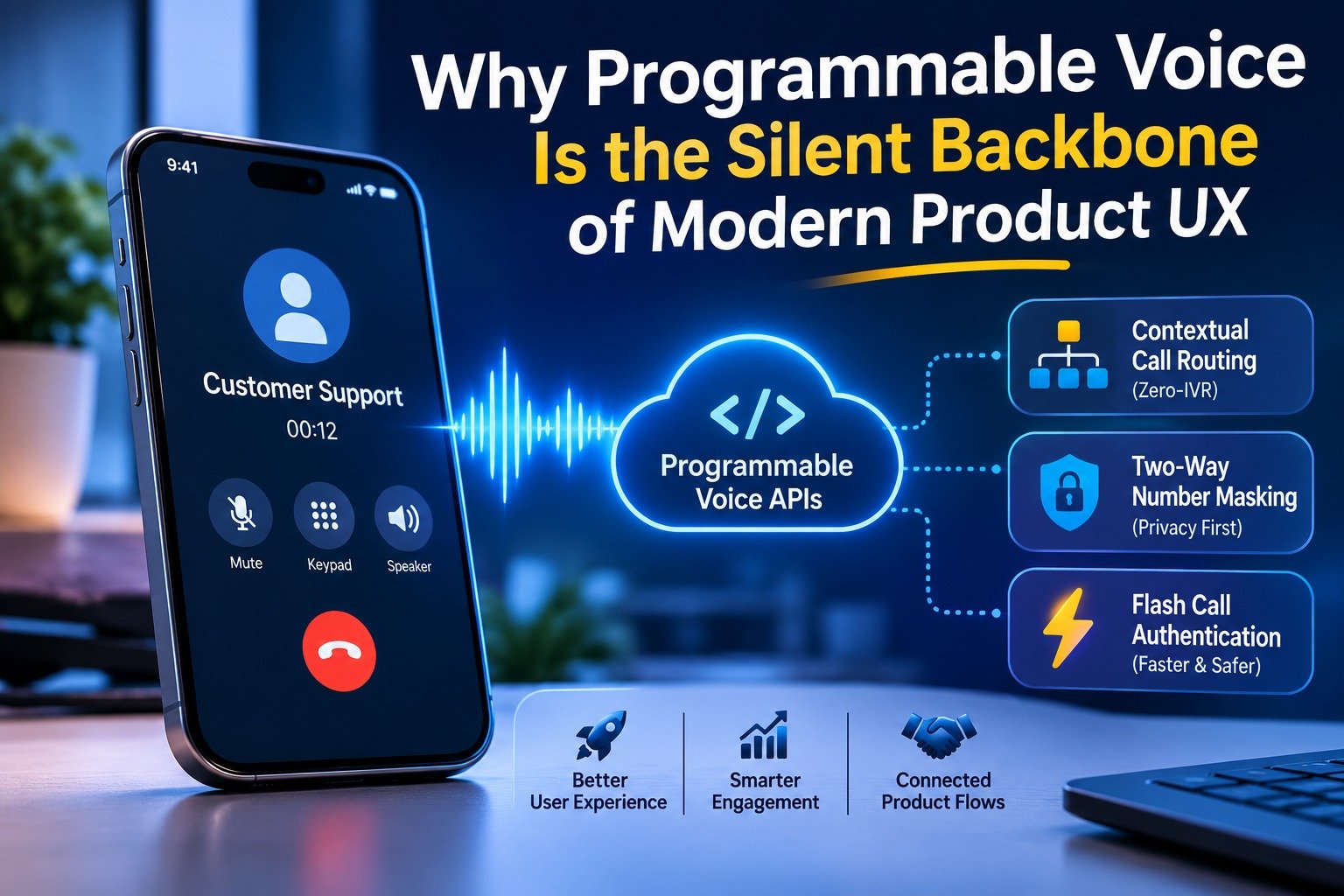
A. Contextual Call Routing (Zero-IVR)
Instead of forcing customers through a 5-step “Press 1 for Sales” tree, programmable voice queries your database the instant a call hits the gateway.
- Scenario: A user has an active delivery out for dispatch.
- Logic: If order.status == ‘in_transit’, the backend bypasses the main menu entirely and routes the call directly to that specific driver or support pod with a warm screen-pop.
B. Two-Way Number Masking & Privacy Triggers
Modern logistics, ride-hailing, and telehealth apps rely on temporary virtual proxies (DID numbers). When a delivery driver calls a customer:
- The app routes the call through a temporary relay number.
- The customer sees a local phone number on their caller ID.
- Both parties keep their personal phone numbers completely private.
- The system automatically tears down the session mapping once the transaction closes.
C. Flash Call Authentication
SMS OTPs face rising delivery latency and SIM-swap vulnerabilities. Programmable voice enables Flash Call Verification-generating a momentary missed call to the user’s device where the last 4 to 6 digits of the incoming phone number act as the one-time verification token. It’s faster, less susceptible to interception, and cuts authentication costs significantly.
3. Traditional Cloud PBX vs. Programmable Voice APIs
| Capability | Legacy Cloud PBX | Programmable Voice APIs |
| Control Layer | Static admin GUI dashboards | Dynamic code (REST, Webhooks, SDKs) |
| Data Integration | Periodic batch syncs | Real-time event-driven execution |
| User Identification | Basic Caller ID lookup | Deep context matching via backend DB |
| Use Case Scope | Internal business communication | Embedded product features & user flows |
The Shift Ahead
Cloud telephony is no longer just about replacing desk phones with softphones. The true power lies in treating voice as a programmable interface layer—one that connects user intent with backend software instantly.
As applications become more automated, the product teams that integrate telecom directly into their core application stack will deliver the cleanest, lowest-friction experiences.
What unique voice-driven workflows is your team building? Let’s discuss in the comments below!