

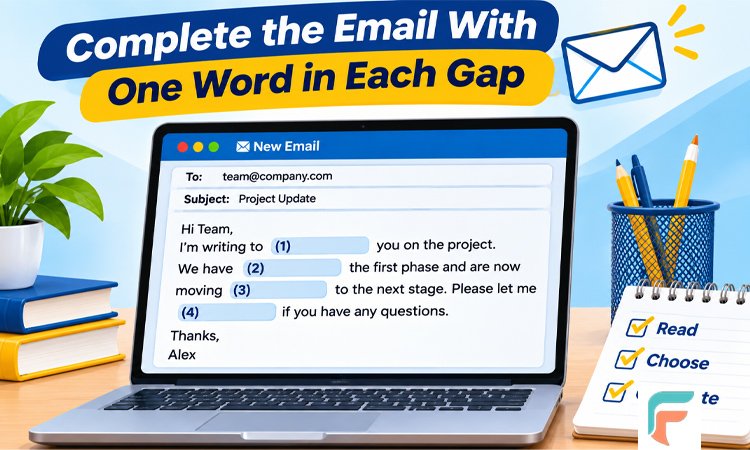
You open an English test. There is a short email on the page, and some words are missing. The instruction says: “Complete the email with one word in each gap.” Many students feel stressed when they see this task. The good news is that it is much easier than it looks. You only need a clear method and some practice.
In this guide, you will learn what this task is, where you will see it, and how to do it step by step. You will also find a practice email with answers, a list of common mistakes, and 10 frequently asked questions. Everything is written in simple English, so you can read it without any problem.
What Does “Complete the Email With One Word in Each Gap” Mean?
This is a gap-fill task. You get a short email, and some words are missing. Each missing word is shown as a gap, which is an empty space or a line. Your job is to write the correct word in each gap.
The most important rule is in the instruction: one word in each gap. You must not write two words or a short phrase. For example, if the correct answer is “in”, you cannot write “in the”. Only one word is allowed.
In English classes, this kind of task has a special name. Teachers call it an open cloze. “Open” means there are no answer choices to pick from. You must think of the word yourself. This is harder than a multiple-choice task, but it is also a great way to learn how English really works.
Where Do You See This Task?
You can find this task in many places. Here are the most common ones.
1. Cambridge A2 Key exam. In the A2 Key Reading and Writing paper, Part 5 is an email task. According to Cambridge English, the text is usually a short email, postcard, letter or message. There are six gaps, and you write one word in each gap. There is also an example at the start, so you can see how it works.
2. Cambridge B1 Preliminary exam. In the B1 Preliminary Reading paper, Part 6 is the last part. You read a short text with six gaps and write one word for each gap. This part is worth up to six marks. The text is not always an email, but the skill is the same.
3. School and class worksheets. Many teachers use gap-fill emails because they are short and practical. Students can finish one in about ten minutes.
4. Job tests and training courses. Some companies use the same idea in language tests. They want to see if you can write clear and correct emails at work.
What Is This Task Really Testing?
It is not a test of difficult words. The words you need are usually very small and very common. The Cambridge teacher notes say that the task tests the word class and the form of the word. Word class means the kind of word, for example a preposition, an article, a pronoun or a verb.
Another source, the ESL Lounge exam guide for B1 Preliminary, says the missing words are usually grammar words. These include pronouns, articles, prepositions and auxiliary verbs. An auxiliary verb is a helper verb, such as “have”, “do”, “will” or “is”.
So the task checks if you know how English sentences are built. It also checks if you know fixed phrases, like “thank you for” or “look forward to”. Phrasal verbs also appear, such as “turn on” or “look after“.
The Most Common Types of Missing Words
Before you learn the steps, it helps to know what kinds of words often go in the gaps. Here is a simple table.
| Word type | Examples | Example sentence |
|---|---|---|
| Prepositions | in, on, at, for, to, of, with | I will see you on Friday. |
| Articles | a, an, the | We stayed in a small hotel. |
| Pronouns | I, you, it, them, my, your | Please send me the photos. |
| Auxiliary verbs | is, are, have, do, will, can | She has finished her homework. |
| Conjunctions | and, but, so, because, if, when | I was tired, but I went out. |
| Quantity words | some, any, much, many, few | There isn’t any milk left. |
| Question words | what, where, when, how | Tell me where you want to go. |
If you learn these small words well, you can answer most gaps in this kind of task.
5 Easy Steps to Complete the Email With One Word in Each Gap
Now let’s look at the method. Follow these five steps every time, and the task will become much easier.
Step 1: Read the Whole Email First
Do not start with the first gap. First, read the full email from the beginning to the end. Try to understand the main idea. Who is writing? Who is the reader? Is it a friendly email or a formal one? What is the email about?
The Cambridge teaching notes give the same advice. They say a gap can depend on information from a different part of the text, not only the words next to it. If you understand the story, you will find the answers faster.
Step 2: Look at the Words Before and After the Gap
Now go to the first gap. Read the words just before it and just after it. These words are your biggest clues.
For example:
Thank you ____ your email.
The word before the gap is “you”, and the word after is “your”. You probably know the phrase “thank you for“. So the answer is “for”.
Sometimes you need to read the whole sentence to be sure. That is fine. Always check the full sentence, not only two or three words.
Step 3: Decide What Type of Word Is Missing
Ask yourself a simple question: what kind of word fits here? Is it a verb, a preposition, an article, a pronoun or a conjunction?
Look at this sentence:
I ____ waiting for your reply.
There is no verb to show the time. The sentence needs a helper verb. It could be “am” or “was”. The word type is clear now: it is an auxiliary verb. Next, you just choose the right form.
In the real exam, you do not get a hint about the word type. Cambridge says the hints in brackets appear only in the practice handout. In the real test, you must decide by yourself. That is why this step is so important.
Step 4: Choose the Correct Form
Finding the word type is not enough. You must also choose the right form. Think about these points:
- Tense: Is the sentence about the past, the present or the future?
- Singular or plural: Is the subject one thing or many things? (“She is” but “They are“)
- Subject or object: Do you need “I” or “me”? “He” or “him”?
- Possessive: Do you need “my”, “your” or “their”?
Let’s try one more example:
Yesterday, we ____ to the beach.
“Yesterday” tells you it is the past. The missing word is a past tense verb. The answer is “went”.
Step 5: Check Your Spelling and Read the Email Again
When all gaps are full, read the whole email again. Does it sound natural? Does each sentence make sense?
Also check your spelling. Cambridge says that spelling must be correct, so a good idea with the wrong spelling can still lose the mark. Write clearly, too, so the reader can see each letter.
If you are not sure about a gap, do not leave it blank. A blank gap cannot get a mark. It is better to write your best guess. Many gaps have more than one correct answer, so your guess may be right.
Practice: Try It Yourself
Here is a short email for you. Fill each gap with one word. Try to do it before you look at the answers.
Subject: Plans for the weekend
Hi Emma,
Thanks (1) ____ your message. I am really happy that you are coming to visit me (2) ____ Saturday.
Let me tell you the plan. First, we will have lunch (3) ____ a small café near my house. It is famous (4) ____ its homemade soup. After that, we can walk in the park if the weather (5) ____ good. If it rains, we (6) ____ go to the cinema instead.
See you soon!
Anna
Answers and Explanations
- for. We say “thanks for” something.
- on. We use “on” with days of the week.
- at or in. Both are correct here. You can say “lunch at a café” or “lunch in a café”. This is an example of a gap with more than one good answer.
- for. We say “famous for” something.
- is. After “if”, we use the present simple for a future plan. “The weather is good” is correct.
- can or will. Both fit the meaning. Remember, you only write one of them.
How many did you get right? If you got four or more, that is a good start. If you got fewer, do not worry. Read the explanations and try another email tomorrow.
Common Mistakes to Avoid
Even good students make small mistakes in this task. Here are the most common ones.
Writing more than one word. This is the biggest mistake. Cambridge says that if a candidate writes more than one word, they will not get the mark. Always check that you wrote just one word.
Forgetting to read the whole text. If you only look at the words near the gap, you may choose a word that does not fit the full story.
Using the wrong tense. Look for time words like “yesterday”, “now”, “tomorrow” and “last week”. They show you which tense to use.
Mixing up similar prepositions. Words like “in”, “on” and “at” cause many mistakes. Learn them in phrases, not alone. For example: “at night”, “on Monday”, “in July”.
Making spelling mistakes. A correct word with wrong spelling does not get a mark. Practise the spelling of common words like “because”, “friend”, “different” and “which”.
Leaving a gap empty. A blank gap can never get a mark. Always try an answer.
Using a difficult word. Students often think that a hard word is a better answer. This is not true. Simple words are usually correct.
How to Improve Your Skills Fast
You do not need to study for hours every day. Short and regular practice is better. Here are some ideas that work well.
Read real emails. Read emails and short messages in English. Notice the small words, like prepositions and articles. You will start to see patterns.
Learn phrases, not single words. Instead of learning “for” alone, learn “thank you for”, “famous for” and “look for”. Your brain will remember whole phrases more easily.
Do one short task each day. Ten minutes is enough. Cambridge teacher notes suggest about ten minutes for one sample task. Use a timer to practise working fast.
Check your answers and learn from them. Do not only count the marks. Ask why you made each mistake. Write the correct phrase in a notebook.
Make your own gap-fill emails. Write a short email, then remove six small words. Give it to a friend to complete. This idea also comes from the Cambridge teacher notes, and it is a fun way to learn.
Work with a partner. Compare your answers. If you have different answers, talk about why. Sometimes both answers are right!
Useful Phrases for Email Gaps
Many gap-fill emails use the same phrase again and again. Learn these, and you will feel more confident.
- Thank you for your email.
- I am writing to ask about…
- I look forward to hearing from you.
- I am sorry for the late reply.
- Could you please send me more information?
- I would like to invite you to my party.
- Let me know if you can come.
- I am looking for a new flat.
- We are going to meet at six o’clock.
- Do not forget to bring your book.
Final Thoughts
The task “complete the email with one word in each gap” looks small, but it teaches you a lot. It helps you with grammar, vocabulary and real email writing at the same time. If you remember the five steps, you can do it with confidence: read the whole email, check the words around the gap, decide the word type, choose the right form, and check your spelling.
Do not worry about making mistakes. Every mistake shows you what to learn next. Try one practice email today, and then try another one tomorrow. Small steps every day will take you far.
Frequently Asked Questions (FAQs)
1. What does “one word in each gap” mean?
It means that you can write only one word in every empty space. You cannot write two words or a whole phrase. In the Cambridge A2 Key exam, if you write more than one word, you do not get the mark for that gap.
2. Is this task the same as an open cloze?
Yes, it is very similar. An open cloze is a text with gaps that you complete with a suitable word, and there are no answer choices. A gap-fill email is one kind of open cloze.
3. How many gaps are there in the exam?
In both the Cambridge A2 Key (Reading and Writing Part 5) and the B1 Preliminary (Reading Part 6), there are six gaps. A2 Key also shows one example gap at the start to help you.
4. What kinds of words go in the gaps?
Mostly small grammar words. These include prepositions, articles, pronouns, auxiliary verbs and conjunctions. Sometimes you also need a verb or a word from a fixed phrase.
5. Can a gap have more than one correct answer?
Yes. Cambridge says that some gaps have more than one acceptable answer. But you must still write only one word. If you are not sure which one is better, choose the one you feel most confident about.
6. What should I do if I do not know the answer?
Do not leave it blank, because a blank cannot get a mark. Read the sentence again and think about the word type. Then write your best guess and move on. You can come back later if you have time.
7. Do spelling mistakes matter?
Yes. Spelling must be correct to get the mark. If you are not sure about a spelling, choose a different correct word that you can spell with confidence.
8. Do contractions like “don’t” or “I’m” count as one word?
This depends on the test or the teacher. Some school books say that a contraction counts as one word, while some online guides say it counts as more than one. The safest way is to read the instructions carefully. If you are not sure, ask your teacher or choose a full one-word answer instead.
9. How long should I spend on this task?
For practice, about ten minutes for one email with six gaps is a good target. In the B1 Preliminary exam, the whole Reading paper is 45 minutes, so you must plan your time well across all six parts.
10. How can I get better at this task quickly?
Read many short emails in English and learn common phrases. Practise one task every day, and check your mistakes. Learn prepositions in phrases, such as “good at”, “interested in” and “afraid of”. After a few weeks, you will see a big change.